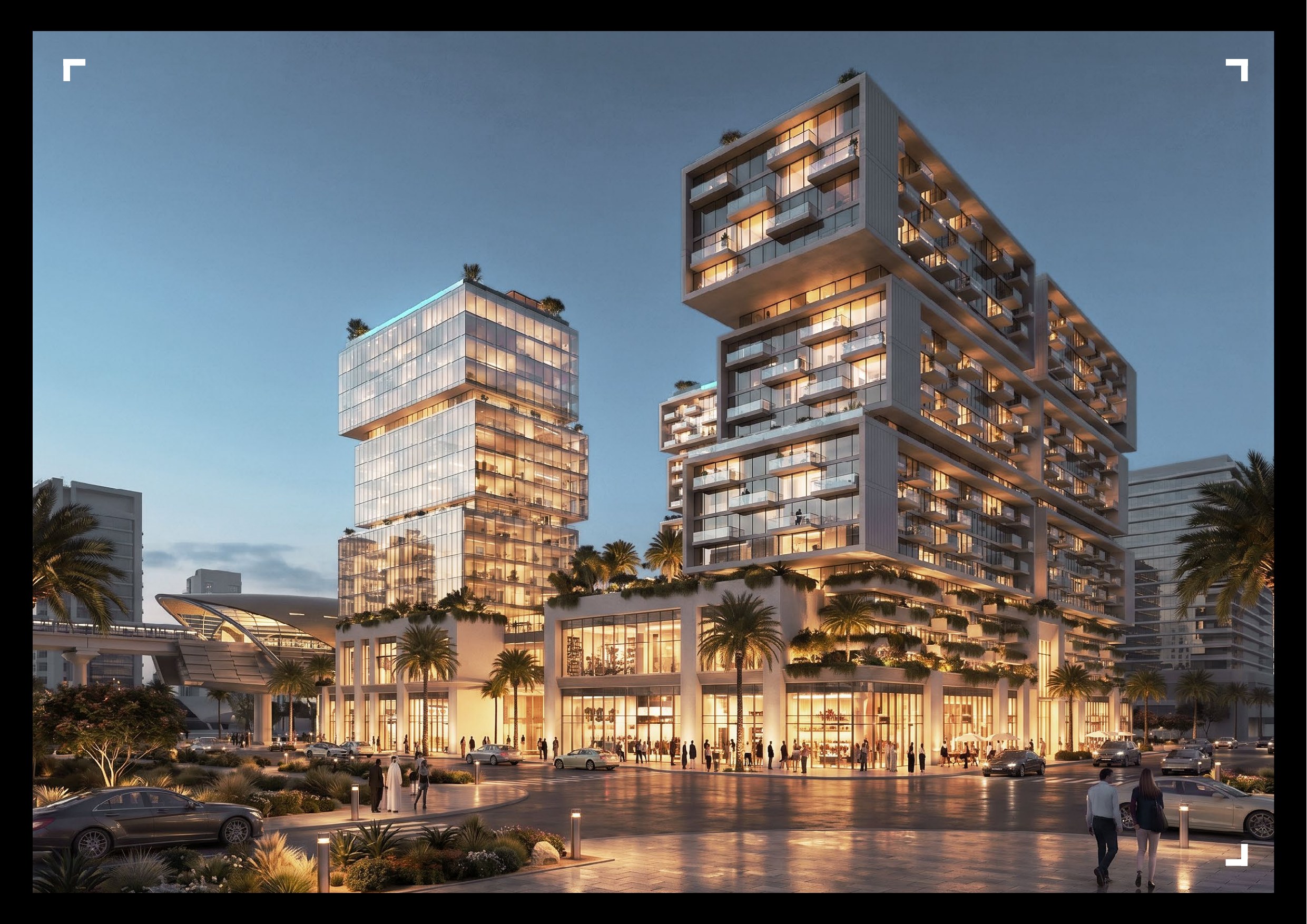
Every second Dubai off-plan brochure uses the words "metro-accessible." Almost none of them mean what RAW District means. A dedicated pedestrian bridge from the building directly into the station concourse. Residential properties within a 15-minute walk of a Dubai metro station outperformed the wider market by 26.7% on average over 12 years, according to CBRE's 2023 Metro Report. Commercial properties within 700–900 metres of a station saw values rise by approximately 76% in an academic study peer-reviewed by the Journal of Transport and Land Use. Whether RAW District captures those numbers is a specific question, and the answer depends almost entirely on what "metro access" actually means at this address.
What the metro data actually says
CBRE's Dubai Metro Report 2023 analysed close to 74,000 residential sales transactions from Q1 2010 to Q4 2022. One of the most comprehensive data sets on this question. Properties within a 15-minute walk of a Red Line station saw prices increase by 26.7% on average over that period, against Dubai's wider average of 24.1%. The 10 to 15-minute walking-distance band specifically recorded 43.8% average appreciation. A premium driven largely by the corridor effect of stations that anchor commercial and hospitality clusters.
The commercial picture is more striking. A peer-reviewed study published in the Journal of Transport and Land Use, using hedonic pricing methods across both residential and commercial transactions, found the effect of the metro on commercial property values was largest within 701 to 900 metres of a station. Approximately 76%. The mechanism is straightforward: office and retail occupiers in Dubai save AED 1,500–2,000 per space per month on car parking when their staff can commute by metro. That cost saving is ultimately reflected in what they will pay for proximate space.
Both sets of numbers are averages across the metro corridor as a whole. What they do not tell you is how unevenly that appreciation is distributed. The buildings that captured the full premium share one characteristic: genuinely uninterrupted, walkable access to the station. Not 700 metres on a map, but 700 metres without crossing six lanes of traffic in 40-degree heat. That distinction is precisely where most "metro-adjacent" marketing falls apart, and precisely where RAW District does not.
RAW District: what makes it structurally different
RAW District sits on Sheikh Zayed Road in Jebel Ali, and it has a purpose-built pedestrian bridge connecting the development directly into the metro station concourse. Not adjacent to the station. Not within walking distance. Into it. Covered, climate-controlled, from the lobby. That is an infrastructure characteristic I have not seen replicated in Dubai's current off-plan supply at this price point.
The bridge matters functionally: it converts metro access from a 10-minute walk into a 90-second crossing, which is the difference between a resident commuting by metro daily and treating it as an emergency option. A furnished studio tenant in RAW District working at DIFC, Business Bay or Downtown has a car-free commute that is genuinely competitive with driving. That widens the tenant pool considerably and anchors the yield case on real demand rather than aspirational tenancy.
It also matters for resale legibility. "Direct metro bridge" survives translation into every language spoken by Dubai's buyer and tenant base. When a Hong Kong family office or a French expat is assessing the secondary market at handover, the bridge is visible, verifiable and impossible to argue away. It does not require them to understand the Jebel Ali submarket. That is a liquidity advantage that is easy to underestimate and very hard to create after the fact.
"The 10–15 minute metro walking-distance band recorded 43.8% average appreciation in CBRE's 12-year data set. The buildings that captured the full figure have one thing in common: you could walk from front door to platform without crossing a road."
The commercial case. And why it changes the asset mix argument
RAW District is not a pure residential play. It is a mixed-use development: furnished apartments from AED 650K, offices from AED 1.2M and retail from AED 2.5M. The 76% commercial capital appreciation figure for metro-adjacent property in Dubai is directly relevant here, and it changes how investors should think about the product mix.
Office space on SZR at AED 1.2M entry, directly metro-connected, sits in a category that is genuinely undersupplied. Dubai's grade-A office stock is concentrated in DIFC and Business Bay, with rents at AED 250–350 per square foot and vacancy rates under 5%. The tenant who cannot afford DIFC but needs quality connectivity. The mid-tier financial services firm, the regional HQ for a European company. Has historically had limited options on the SZR spine at accessible price points. RAW District's office component targets exactly that gap.
Retail in a directly metro-connected building on a high-footfall SZR location is a different conversation to retail in a community mall in Dubailand. The captive audience. Building residents, office workers, metro commuters transiting through the concourse. Creates a traffic base that freestanding retail cannot replicate. From AED 2.5M, the retail entry price is not low, but for the right operator the yield case is compelling.
The risk for all three asset classes is the same: Imtiaz is not Emaar, and the Jebel Ali corridor is still establishing its demand profile. Imtiaz has a strong track record of on-time delivery and market outperformance in their completed projects. Which matters because delays compress the yield window and erode the exit case. That track record is a genuine positive; what remains to be tested is whether it holds at this scale and address profile.
My read on the entry price
AED 650K for a furnished studio on Sheikh Zayed Road with a direct metro bridge is competitive. Select Group's Peninsula Two on Business Bay Canal. A 5-minute walk to Business Bay station, no bridge. Launched studios at AED 820K. Binghatti Phantom in Business Bay, without direct metro access, priced studios at AED 750K–900K and now trades in the secondary market above AED 1.1M. Neither had a bridge. RAW District's entry price does not appear to be paying a premium for the metro infrastructure. It is, if anything, priced below what equivalent connectivity has commanded in more established submarkets.
That gap narrows at handover if the Jebel Ali corridor attracts the tenant profile the metro access implies. It persists if it does not. The honest answer is that the western SZR spine is earlier in its residential demand arc than Business Bay or JBR. And early stage means both the upside case and the risk of underdelivery are real. The 35% metro premium is an average; not every metro-adjacent project captures it.
RAW District is not a waste of cash. The metro bridge is structurally different to everything else that claims metro proximity at this price point in Dubai, and the 35% residential and 76% commercial appreciation data for genuine metro-connected product makes the investment case. The risk is the corridor, not the asset. Jebel Ali's demand profile over the next 3 years will determine whether RAW District captures the full metro premium or a fraction of it. Imtiaz's delivery track record is a genuine positive. I would not buy retail or office here without a specific occupier thesis. But for the residential studio at AED 650K, the entry is sensible for a capital growth and yield investor with a 3-year horizon.
Data sources: CBRE, The Dubai Metro Report 2023. 74,000 residential sales transactions Q1 2010–Q4 2022; Luca Bertolini et al., "The effect of the Dubai Metro on the value of residential and commercial properties", Journal of Transport and Land Use (JTLU); Imtiaz Developments project brochure and pricing sheet, June 2026. This is an editorial opinion piece, not financial advice. Consult a qualified advisor before making investment decisions.